Lean in an SME: reducing the lead time from quote to delivery
POMEX’s work with an industrial packaging SME.
In an SME that produces to order, every day saved between the customer’s request and delivery counts.
Our client wanted to shorten this lead time, from issuing the quote to the finished product. POMEX mapped the real flow and implemented a Lean and Quality approach.
01. Context and challenge
The assessment carried out with management revealed several obstacles:
- highly seasonal activity, with temporary staff at peak times and a risk of short-time working the rest of the year;
- highly variable orders, from a few dozen to tens of thousands of pieces, for customers with customised requests;
- strong dependence on suppliers and subcontractors: an upstream error led to many corrections at the end of the chain;
- several days to issue a quote and a low quote-to-order conversion rate;
- difficulty finding the history of similar orders and managing repeat orders.
02. Our approach
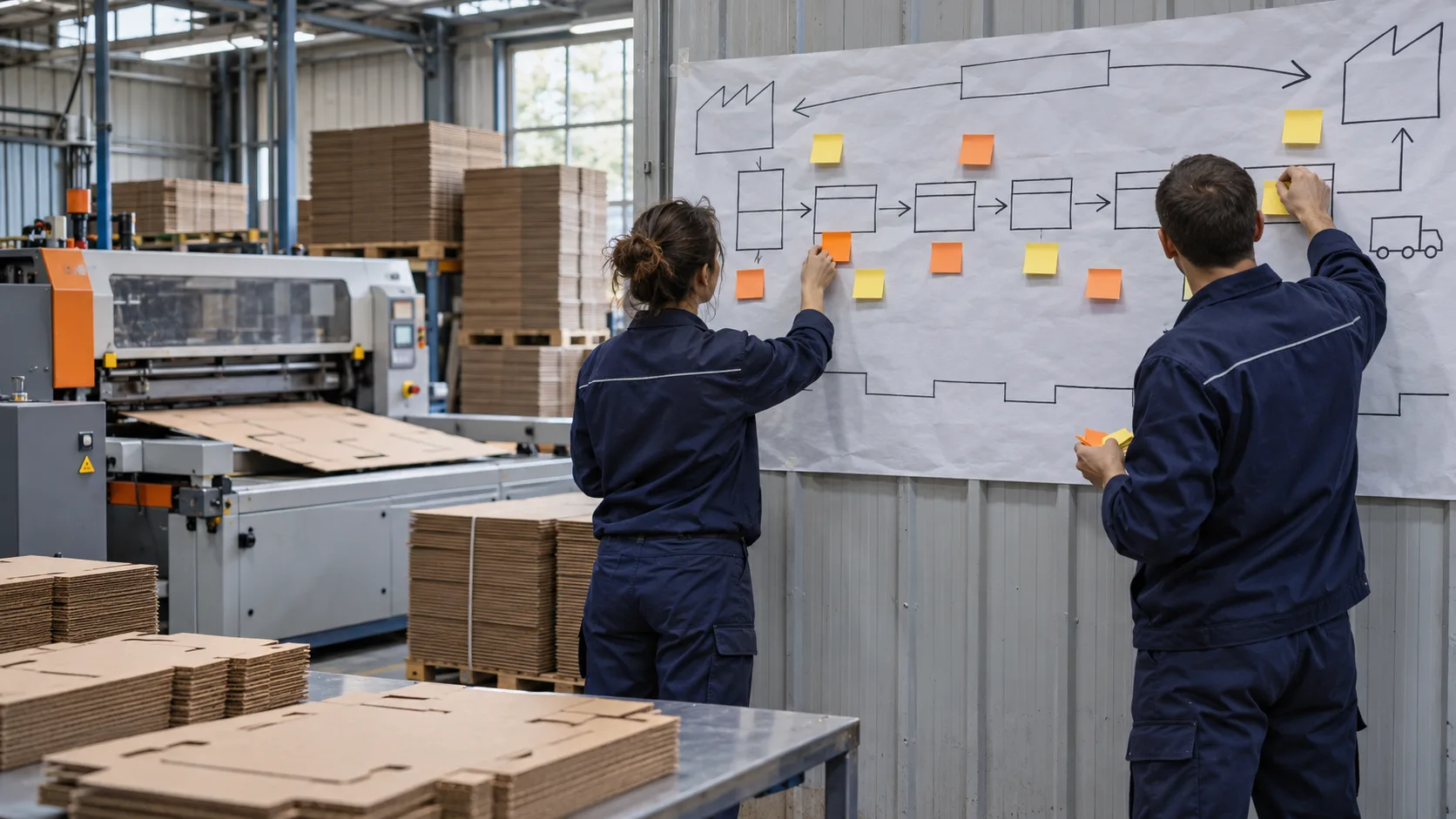
After a one-day audit, interviews, group workshops and field observations, POMEX built a value stream map (VSM) of the main flow, as it is actually experienced rather than as described in procedures. On this basis, we:
- measured the time of each step and removed non-value-added tasks;
- defined buffer zones between machines and introduced a pull flow;
- organised workstations so that problems become visible immediately;
- allocated tasks according to workload, reassigning resources instead of resorting to short-time working;
- standardised the product technical sheet, including the history of corrections;
- strengthened quality and lead-time requirements for suppliers.
03. Results
The approach gave the company a faster and more flexible organisation:
- a clear, shared view of the flow, from customer request to delivery;
- shorter response times, from quote to finished product;
- faster quotes and repeat orders thanks to standardised technical sheets;
- fewer end-of-chain corrections thanks to better supplier follow-up;
- an organisation that copes better with peaks and troughs in activity.

Conclusion
In an SME, Lean starts with a simple question: what really happens between the customer’s request and delivery? By answering it together, our client gained in lead time, responsiveness and peace of mind.